Ankylosing Spondylitis: Can the Root Drivers Be Addressed?
Quick answer: Ankylosing spondylitis (AS) is a chronic inflammatory arthritis that mainly affects the spine and sacroiliac joints, causing back pain and stiffness. At Deeper Healing in Charleston, SC, we complement your rheumatology care by looking at the deeper root drivers — immune dysregulation, gut-microbiome imbalance, and environmental triggers — that can fuel the inflammation, and by supporting the body in a deliberate order.
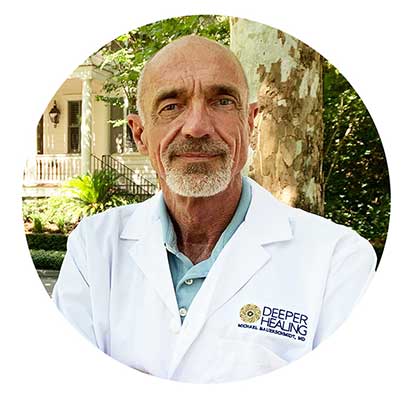
Updated: August 25, 2026 · Reviewed by Michael Bauerschmidt, MD
Key takeaways
- Ankylosing spondylitis is a form of inflammatory arthritis (a spondyloarthritis) that primarily inflames the spine and sacroiliac joints.
- It is strongly linked to the HLA-B27 gene, though not everyone who carries the gene develops the disease.
- According to MedlinePlus (U.S. National Library of Medicine), AS affects the eyes in more than 30% of cases — one reason it is considered a whole-body inflammatory disease, not only a spine condition.
- Researchers recognize a close association between AS and gut inflammation and microbiome imbalance.
- Prescribed treatments such as NSAIDs and biologics help control inflammation — never stop or change them without your rheumatologist.
- A root-cause, functional and environmental medicine approach works alongside standard rheumatology care to support immune balance and overall wellness.
What is ankylosing spondylitis?
Ankylosing spondylitis is a chronic, autoinflammatory type of arthritis that mainly affects the spine and the sacroiliac joints where the spine meets the pelvis — and understanding its root drivers means looking beyond the joints themselves. Persistent inflammation in these joints causes pain and stiffness and, over time, can lead new bone to form and vertebrae to fuse, reducing spinal flexibility. It belongs to a family of related conditions called spondyloarthritis, is strongly associated with the HLA-B27 gene, and according to the National Institute of Arthritis and Musculoskeletal and Skin Diseases (NIAMS) most often develops before age 45.
What are the symptoms of ankylosing spondylitis?
Because AS is driven by inflammation, symptoms tend to build gradually and are often worse with rest and better with movement:
- Chronic low back and buttock pain, often worse in the morning or at night
- Stiffness that eases with activity and exercise
- Reduced spinal flexibility over time
- Pain where tendons and ligaments attach to bone (enthesitis), such as the heels
- Hip, shoulder, or other joint pain
- Fatigue
- Eye inflammation (uveitis) causing redness and pain
- Reduced chest expansion and, in some, gut inflammation
What causes ankylosing spondylitis — and why standard care can miss the deeper drivers
The exact cause of AS is not fully understood, but it reflects an over-active, dysregulated immune response in genetically susceptible people — most of whom carry the HLA-B27 gene. Standard rheumatology care is essential and focuses on controlling that inflammation with NSAIDs and, when needed, biologic medications. What conventional care is not designed to explore in depth is why the immune system is running hot in the first place. A growing body of research points to the gut: many people with AS have subclinical gut inflammation and an imbalanced gut microbiome (dysbiosis), and AS shares biology with inflammatory bowel disease. Research from the U.S. National Library of Medicine notes that 6% to 10% of people with AS also develop related inflammatory disorders such as psoriasis or inflammatory bowel disease — including ulcerative colitis or Crohn’s disease. Data from the National Institute of Environmental Health Sciences (NIEHS) highlights that environmental exposures — such as mold (mycotoxins), heavy metals, and chemicals — can influence the immune system in susceptible people. As part of the broader family of autoimmune and autoinflammatory conditions we work with, AS often benefits from attention to these deeper drivers alongside specialist treatment.
“Studies show that both genes and environment may lead to the development of the disease,” notes the National Institute of Arthritis and Musculoskeletal and Skin Diseases (NIAMS) — the rationale for examining gut and environmental drivers alongside genetics.
How Deeper Healing supports patients with ankylosing spondylitis
Deeper Healing does not replace your rheumatologist — we work alongside your standard care. Our approach starts with a detailed intake and comprehensive lab analysis to understand the immune, gut, and environmental factors that may be fueling inflammation — including a toxin workup that looks for mold (mycotoxins), heavy metals, and chemicals. From there, Dr. Bauerschmidt and our team support the body in a deliberate order using environmental medicine, light and oxygen therapies, gut and nutritional support, and targeted detoxification. The aim is to reduce the body’s overall inflammatory and toxic burden and support immune balance and quality of life — while you continue the treatments your specialist prescribes.
Once those causative factors — toxins such as mold, heavy metals, and chemicals, chronic infections, and gut issues — have been identified and addressed, we may introduce Low-Dose Allergen (LDA) therapy, a course of tiny intradermal injections that aims to calm and rebalance the immune system and reduce chronic reactivity. Because LDA works to retrain immune tolerance rather than simply suppress symptoms, it may, over time, help reduce reliance on medications for some patients. This is always done in coordination with your rheumatology care, and is never a reason to stop prescribed medication on your own.
Conventional care vs a root-cause approach
| Conventional rheumatology care | Deeper Healing root-cause support (alongside) |
|---|---|
| Confirms AS with imaging, HLA-B27, and inflammatory markers | Adds testing for gut health, toxins (mold/mycotoxins, heavy metals, and chemicals), and immune drivers |
| Controls inflammation with NSAIDs and biologics | Supports the terrain that keeps the immune system inflamed |
| Focuses on the joints and spine | Also addresses the gut microbiome and environmental burden |
| Manages the disease over time | Aims to support overall wellness — never a replacement for specialist care |
Key terms explained
- HLA-B27
- A genetic marker strongly associated with ankylosing spondylitis. Carrying it raises risk, but many carriers never develop the disease and some patients with AS do not carry it.
- Spondyloarthritis
- The broader family of inflammatory rheumatic diseases to which AS belongs, which can involve the spine, peripheral joints, entheses, eyes, skin, and gut.
- Sacroiliitis
- Inflammation of the sacroiliac joints, where the base of the spine meets the pelvis. It is a hallmark early feature of AS and a common source of the buttock and low-back pain.
- Enthesitis
- Inflammation at the sites where tendons and ligaments attach to bone, such as the heel. It is a characteristic feature of spondyloarthritis like AS.
- Uveitis (iritis)
- Inflammation inside the eye that can cause redness, pain, and light sensitivity. It is the most common non-joint feature of AS, affecting more than 30% of patients over time.
- Ankylosis
- The progressive fusion of spinal bones that can occur in advanced AS as new bone forms across inflamed joints, gradually stiffening the spine.
- Dysbiosis
- An imbalance in the gut microbiome. Research links gut dysbiosis and intestinal inflammation to the immune activity seen in ankylosing spondylitis.
- Biologics
- Prescription medications (such as TNF or IL-17 inhibitors) that target specific parts of the immune system to control AS inflammation. They are managed by your rheumatologist.
Patient experience
Many patients come to us managing an inflammatory condition with their specialist while still searching for what is driving the inflammation underneath. Read how a root-cause approach complements standard care: Deeper Healing patient stories →
Frequently asked questions
Can ankylosing spondylitis be reversed or cured?
There is currently no cure for ankylosing spondylitis, and we never promise one. With good specialist care many people control inflammation and stay active for decades. Our role is to support the body’s underlying immune, gut, and environmental terrain alongside that care, with the goal of reducing overall inflammatory burden and supporting wellness — not replacing your prescribed treatment.
What is the root cause of ankylosing spondylitis?
There is rarely a single cause. AS reflects a dysregulated immune response in genetically susceptible people, most of whom carry the HLA-B27 gene. Research increasingly points to the gut — microbiome imbalance and intestinal inflammation — as well as environmental immune stressors. We focus on identifying which of these drivers may apply to you, working alongside your rheumatologist.
Is ankylosing spondylitis autoimmune?
AS is an immune-mediated inflammatory arthritis. It is often described as autoinflammatory or autoimmune, because the immune system drives chronic inflammation of the spine and joints. That immune dysregulation — and the genetic and gut factors behind it — is exactly what a functional and environmental medicine approach aims to understand and support.
What is the link between ankylosing spondylitis and gut health?
Researchers recognize a strong association between AS and the gut. Many people with AS have subclinical gut inflammation and an imbalanced microbiome, and AS shares biology with inflammatory bowel disease. Because of this connection, we place particular emphasis on assessing and supporting gut health as part of a whole-body approach, alongside your specialist’s treatment.
What tests are used to diagnose ankylosing spondylitis?
Diagnosis is made by a physician using your history and exam, imaging of the spine and sacroiliac joints (X-ray or MRI), HLA-B27 genetic testing, and inflammatory markers such as CRP and ESR. We may add functional testing of gut health, nutrient status, and toxic burden to understand the drivers of inflammation, but diagnosis and staging belong with your rheumatologist.
Does Deeper Healing replace my rheumatologist?
No — we complement your standard care. Ankylosing spondylitis needs ongoing specialist management, and we work alongside your rheumatologist, not in place of them. Our focus is supporting the immune, gut, and environmental factors that influence inflammation and overall wellness. We encourage you to keep all specialist appointments and continue prescribed treatment.
Can I stop my biologic or NSAID medication?
No — never stop or change AS medication on your own. NSAIDs and biologics play an important role in controlling inflammation and protecting your joints, and stopping them can allow the disease to flare. Any change to your medication should be made only by your prescribing rheumatologist. Our support is designed to work alongside those treatments, not to replace them.
Where can I find a root-cause ankylosing spondylitis doctor near me in Charleston, SC?
Deeper Healing Medical Wellness Center is located at 234 Seven Farms Drive, Suite 110, Charleston, SC 29492, on Daniel Island. We see patients from across the region and country who want root-cause support for inflammatory conditions alongside their specialist care. We are happy to coordinate with your existing rheumatology team.
Your next step: find out what’s fueling the inflammation
Because environmental toxins and immune stressors can add to the body’s inflammatory burden in ankylosing spondylitis, a useful first step is understanding your own “body burden.” Our free two-minute assessment helps you gauge whether accumulated toxins could be contributing to your symptoms — and what to consider next, alongside your specialist care.
Take the Toxin Quiz
Two minutes, free, and completely confidential — see whether your body burden of toxins could be adding to your inflammation.
Sources
- National Institute of Arthritis and Musculoskeletal and Skin Diseases (NIAMS) — Ankylosing Spondylitis
- MedlinePlus, U.S. National Library of Medicine — Ankylosing spondylitis (Genetics)
- National Institute of Diabetes and Digestive and Kidney Diseases (NIDDK) — Crohn’s Disease
- National Institute of Environmental Health Sciences (NIEHS) — Autoimmune Diseases
Medically reviewed by Michael Bauerschmidt, MD — Founder and Medical Director, Deeper Healing Medical Wellness Center. Board-certified physician specializing in functional and environmental medicine.
Last reviewed: August 2026.
This page is offered to provide education and isn’t a substitute for professional medical advice, diagnosis, or treatment. Symptoms can have many possible causes, ranging from minor to serious, and what’s true for one person may not be true for another. Always consult a qualified healthcare provider before making any health decisions. This content hasn’t been evaluated by the FDA and isn’t intended to diagnose, treat, cure, or prevent any disease. If you’re experiencing a medical emergency, contact your physician or local emergency services.
If you’d like personalized guidance from Deeper Healing, here is an invitation to learn more. And wherever you are on your journey, we encourage conscious, intentional choices that support your health and the planet’s. Every decision matters.